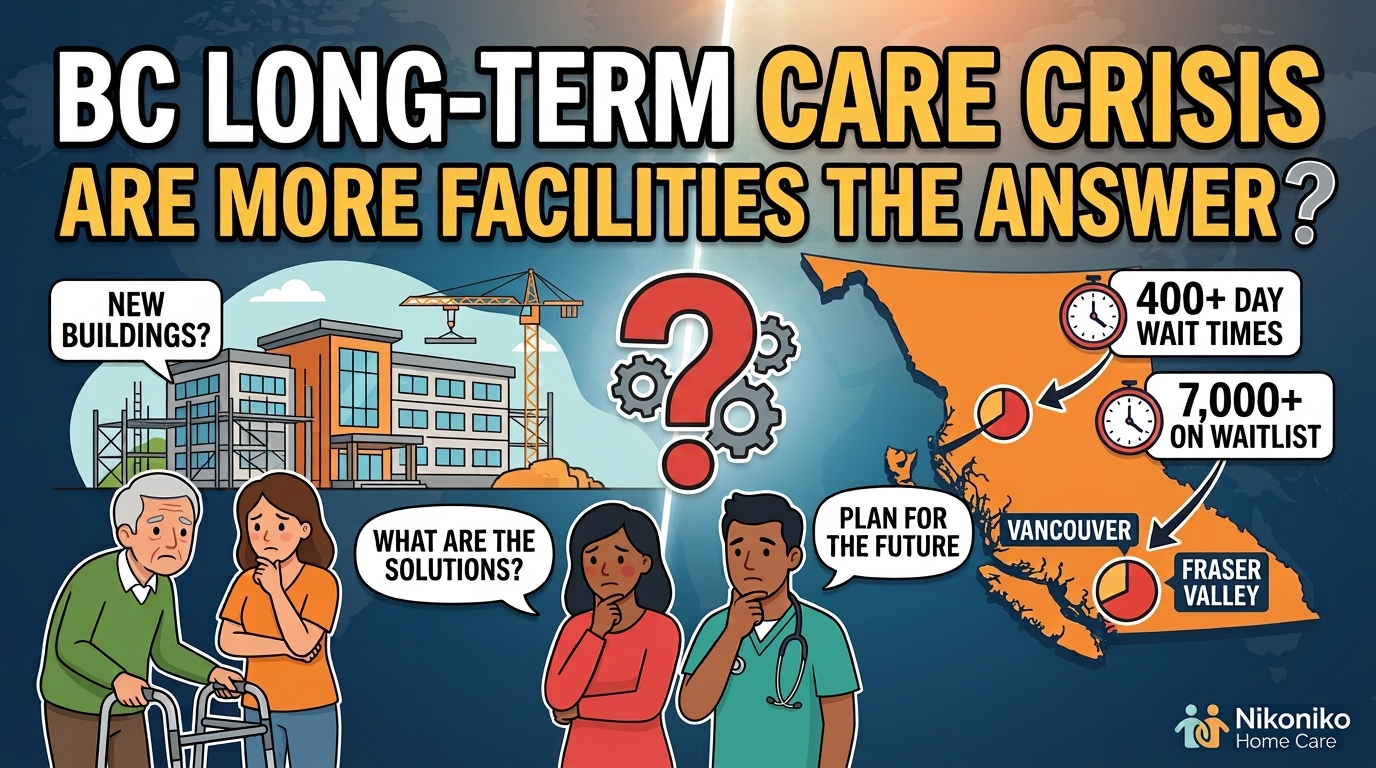

Can We Solve the Problem Simply by Building More Facilities?
As I write this article in mid-October, election campaigns are heating up across British Columbia, with both provincial and municipal elections on the horizon. In a recent leaders’ debate, health care was one of the major topics of discussion.
That is understandable. One of the provincial government’s key responsibilities is to ensure that residents have access to appropriate medical care when they need it. I believe there is merit in the current government’s efforts to expand existing hospitals, establish a new medical school, and increase the number of health care professionals.
However, when it comes to long-term care, I was left with the impression that we still lack clear and effective solutions.
Some patients have completed their hospital treatment and no longer need to remain in hospital, yet they cannot be discharged because they lack the support needed to return home or a suitable place to move to. The need to support these individuals in their homes and communities has been recognized for more than a decade. However, home care services still lack sufficient staff, and the system is not functioning as effectively as it should.
There are also challenges facing the seven planned Long-Term Care (LTC) facility projects, including rising construction costs.
Just How Serious Is the Shortage?
Reports published by BC’s Seniors Advocate, an independent office that focuses on issues affecting older adults, highlight the scale of the challenges facing long-term care.
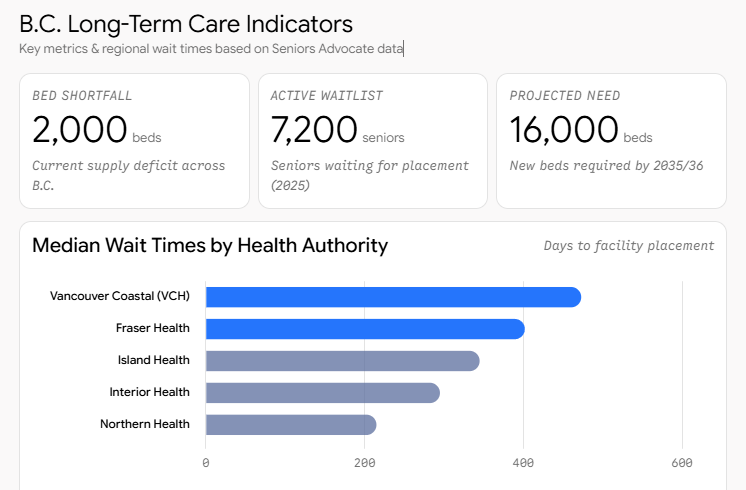
Note: These figures represent different measures and should not be interpreted as different ways of counting the same thing. The projection for future demand is based on anticipated population changes and care needs.
In addition, published figures show that the average wait for a non-urgent admission to an LTC facility from the community is 473 days in Vancouver Coastal Health (VCH) and 402 days in Fraser Health (FH).
These are significant numbers.
For example, building 100 new facilities with 160 beds each would provide a total of 16,000 beds. However, developing that many facilities would require more than land and construction funding. We would also need enough care aides and nurses to provide care to the people living in them.
In other words, this is not a problem that can be solved simply by building more facilities.
So, how should we respond to this situation?
In an Era When Being in a Care Facility Does Not Necessarily Mean Peace of Mind
If people cannot count on entering an LTC facility when they need one, it becomes even more important to help them remain safely at home for as long as possible.
A good starting point is to take care of our own health and daily habits so that we can maintain our well-being and independence for as long as possible.
Of course, even if we remain healthy ourselves, our spouse, parents, or other close family members may eventually need care. Supporting a loved one on our own is not easy.
Even when families want to use publicly funded or private home care services, staffing shortages in some communities can make it difficult to access the support they need.
Furthermore, if BC is to expand its LTC capacity, it will also need more people to work in these facilities.
Where will we find the people who will provide this care, and how will we recruit and retain them?
I believe this is just as important a challenge as building the facilities themselves.
There is another point I would like readers to understand.
When a person experiences cognitive decline and has difficulty making safe decisions about daily living, moving into Assisted Living—which provides housing and support with daily activities while allowing residents to maintain some independence—may no longer be an appropriate option. Depending on the level of care required, a setting that provides more comprehensive support may be necessary.
In other words, the challenge is not simply finding a place to live. We must also ensure that people can access a setting that meets their individual care needs.
What Can We Do Going Forward?
Looking at the current election platforms, I feel that a clear path forward is still lacking, particularly in the area of long-term care. But rather than simply waiting for the government to solve these challenges, I believe there are steps we can take ourselves.
First, let’s start planning for the future before a crisis occurs. Talk with your spouse and family about what kind of support you might need as you grow older, where you would prefer to live, and what options may be available if you need care. Understanding the system before an urgent situation arises can make a difficult time a little easier to navigate.
Second, let’s make our voices heard. The availability of home care, the shortage of LTC beds, and the need for qualified care professionals are issues that affect all of us. By asking questions, sharing our experiences, and raising these concerns with our elected representatives, we can help keep long-term care on the public agenda.
Finally, I believe there is an important role for our Japanese Canadian community to play. How can we help older adults remain independent for as long as possible? How can we support families who are struggling to care for loved ones? And how can we connect people with the right services before they reach a crisis point?
These are questions I want us to explore together.
Through more than ten years of experience in this field, I have learned that admission to an LTC facility is not determined simply by the order in which people apply. Placement decisions take into account individual circumstances and the level of care required. Although average waiting times can be concerning, they do not necessarily reflect how long any one person will wait.
At Nikoniko Home Care, I want to take the next step: to listen to the needs of our community, identify where support is missing, and turn those needs into practical solutions.
Long-term care is not just a government issue, nor is it a problem that affects only older adults. It is a challenge we may all face, either for ourselves or for someone we love.
Let’s start the conversation now, share what we learn, and work together toward a community where people can age with dignity, receive the care they need, and feel that they are not alone.